
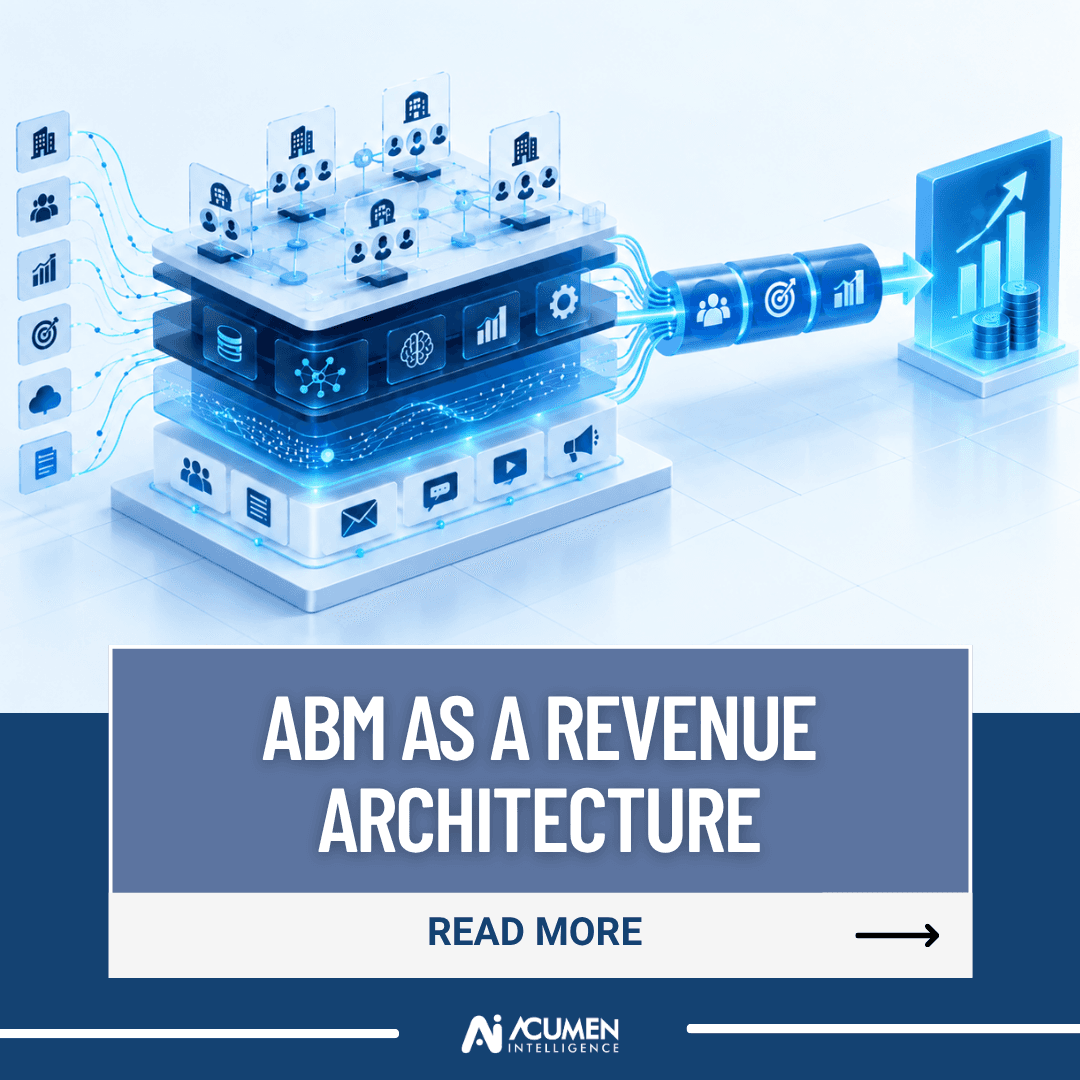
Account-based marketing (ABM) has often been treated as a focused campaign model that involves selecting priority accounts, personalising messaging and coordinating outreach. That view is becoming too narrow. In complex enterprise buying environments, ABM is no longer simply a marketing strategy. It is a revenue architecture connecting account intelligence, buying-group signals, engagement, sales action and pipeline progression.
This is the shift behind account-based revenue engineering. A modern ABM strategy should determine not only which accounts to target, but how the organisation identifies commercial potential, interprets account movement and converts signals into measurable revenue.
ABM Has Outgrown the Campaign Model
Research found that organisations were more likely to reach the highest revenue bands when they implemented sales-led ownership across ABM activities, with 43% of market leaders achieving this compared with 31% of lower-performing peers.
The implication is important. ABM performs differently when ownership extends beyond marketing execution. Account-based marketing should establish shared account priorities, qualification criteria, engagement rules and pipeline outcomes across marketing, sales and revenue operations.
B2B account-based marketing therefore becomes less about running targeted campaigns and more about engineering coordinated commercial action around the right accounts.
Account Targeting as a Live Intelligence Layer
Traditional account targeting begins with firmographic fit such as industry, company size, geography, revenue or technology profile. That remains useful, but fit alone cannot reveal whether an account is moving towards a decision.
Research reports that 87% of B2B buyers identified generative AI conversational search as a meaningful interaction during the buying process.
Important research behaviour is increasingly happening outside owned channels and may never appear as a conventional form fill or website conversion.
A revenue architecture must therefore combine fit with behavioural signals, content engagement, intent data and stakeholder activity. Instead of treating a target-account list as static, teams need a dynamic view of which accounts are commercially relevant now.
The objective is no longer simply to know who fits. It is to recognise when fit becomes readiness.
Connecting Teams Around Shared Revenue Execution
Sales and marketing alignment is often presented as a meeting cadence or shared dashboard. Revenue architecture requires more.
Research reports that 91% of sales professionals believe their sales and marketing teams are somewhat or strongly aligned. It also notes that 73% describe marketing-generated leads as high or very high quality.
Yet fragmented tools, communication gaps and difficulties sharing data remain practical barriers.
For ABM, the next step is operational alignment. Both teams should work from the same account definitions, buying-group view, qualification thresholds, signal priorities and next-best actions.
When an account shows rising intent, the architecture should determine who responds, through which channel and against what commercial objective. Alignment becomes a revenue workflow, not simply organisational agreement.
Measuring ABM Through Account Progression
If ABM is a revenue architecture, measurement cannot stop at impressions, clicks, MQLs or influenced pipeline.
Research highlighted that eight of the top 12 criteria used by leaders to judge B2B marketing are still based on proof of engagement.
Engagement is visible, but visibility does not necessarily prove commercial movement.
A stronger ABM strategy measures account progression through buying-group coverage, intent intensity, sales acceptance, opportunity creation, pipeline velocity and revenue contribution.
The question changes from, “Did the account engage?” to, “Did this activity increase the probability or speed of a revenue outcome?”
The Acumen Intelligence Advantage
Acumen Intelligence helps technology brands build data-driven ABM programmes that connect account targeting, intent signals and buying-group intelligence. By combining account intelligence with personalised engagement, Acumen Intelligence helps brands identify priority accounts, understand buyer behaviour and activate the right stakeholders at the right stage.
The result is an ABM approach focused on account progression, buying-group engagement and qualified pipeline rather than campaign activity alone.
Connect with the Acumen Intelligence Business Development team to explore how a data-driven ABM approach can turn priority accounts and buyer signals into revenue-ready opportunities.